Sunday, June 11, 2006

An Independence Day Tribute

Tomorrow is Independence Day and I have decided to write a tribute to our national heroes, most especially to Graciano Lopez-Jaena, the only Ilonggo to have been declared a national hero. Although much has already been written about him, I feel that now is a good time to examine what lessons we can learn from this extraordinary man.

Born to poor parents, Graciano at an early age showed signs of exceptional intelligence and consistently excelled in school. But even when he was still young, Lopez-Jaena already displayed a rebellious and irreverent streak. This was manifested in 1874 when, at barely 18 years old, Graciano wrote “Fray Botod,” a satirical story about the fat and abusive friar of Jaro. Because of “Fray Botod” and his other subsequent run-ins with abusive Spaniards, the young Graciano was “blacklisted” by Spanish authorities as a “filibuster.” To prevent further trouble with authorities, his wealthy relatives in Jaro agreed to finance his medical studies abroad and young Graciano departed the Philippines for Spain in 1880.

One cannot write about Graciano Lopez Jaena without talking about Jose Rizal and Marcelo H. del Pilar much like one cannot imagine Athos without Porthos and Aramis. The three were the pillars of the Propaganda Movement in Spain. All three possessed exceptional qualities that distinguished them from their peers – equally talented, intellectually gifted, very patriotic and extremely ambitious. And like the Three Musketeers, each particularly excelled in one craft. Of the three, Jose Rizal was the finest writer because his two novels, Noli Me Tangere and El Filibusterismo, inspired the people to revolt against Spain. Marcelo del Pilar was the better propagandist or PR man because, unlike Rizal and Lopez Jaena who both wrote in Spanish, he wrote in Tagalog which was better understood by the hoi polloi. But when it comes to public speaking, no one comes close to Graciano Lopez Jaena.

Graciano may not have been the most fastidious of writers but his oratory skills were legendary. Lopez Jaena was a very powerful, charismatic speaker and it is said that when he spoke about the injustices perpetuated by the Spaniards in the Philippines, his audience would almost always break into tears (including the Spaniards in the audience). Wanting to study and emulate his oratorical style, Jose Rizal once transcribed verbatim one of Graciano’s speeches and found it full of grammatical errors, awkward sentences, etc. Rizal concluded that Lopez-Jaena moves crowds not with elegant words but with his sincerity, his courage and his passion for his country. If he was born today, Graciano would have been the media spokesman of the group and thus would have been more famous than the other two heroes.

Graciano wanted to be the very first Filipino to sit as a member of the Spanish Parliament where he could use his oratorical skills to push for more reforms in the Philippines. But in the end, their lobbying efforts to put a Filipino in the Spanish Parliament ended in failure. The Propaganda Movement disintegrated when financial funding from home dried up and La Solidaridad, the newspaper Graciano founded, had to be collapsed due to lack of funds. Matters became worse when Rizal and del Pilar split over a petty misunderstanding. Giving up, Rizal went back to the Philippines to write his two novels while del Pilar and Lopez-Jaena decided to stay on to continue the fight in Spain.

It is interesting to note that Rizal, del Pilar and Lopez-Jaena all died within the same year: 1896. Graciano was first to die on January 20, del Pilar second on July 4 and Rizal last on December 30. But while Rizal died gloriously in Luneta, del Pilar and Lopez-Jaena both died in some obscure hospital in Spain due to tuberculosis. To this day, Graciano’s remains have not been found and returned to the Philippines because he was buried in an unmarked Barcelona grave.
The deaths of Rizal, del Pilar and Lopez-Jaena marked the end of the Filipinos’ non-violent struggle towards reforms. Soon after their deaths, Andres Bonifacio along with thousands of patriotic Katipuneros rose up in arms against Spain. And the rest, as they say, is history.
(Stateside Ilongga has some interesting photos of the Philippines Independence Day Parade in New York ... here.)

Saturday, June 10, 2006

More on Sunken Capiz "Galleon"

The Philippine Daily Inquirer today has a feature article on the Capiz shipwreck and the Manila Galleon Trade. You can read it here and here. You can also read my blog entry on the same topic which I posted 4 days ago here (Sunken Galleon Discovered Off Capiz Coast).

And if you still couldn't get enough of "Brokeback Mountain," you may also want to check out the interesting article by NEWSBREAK magazine on Filipino transsexuals.

Friday, June 09, 2006

Before Boracay, there was Sicogon

Before Boracay attained international renown, Sicogon island in Iloilo province used to be a favorite destination of tourists. Situated at the north-westernmost part of Panay, Sicogon is part of the Higantes group of islands which is under the territorial jurisdiction of Carles, a small 4th class municipality in Iloilo.

Sicogon used to be popular to tourists for its long stretch of white sand beach, said to be longer than Boracay’s 7-kilometer stretch. It is also known for its lush coral reefs ideal for scuba diving and snorkeling. In fact, the sea surrounding the Sicogon-Higantes island chain is the traditional fishing ground of local fishermen due to its abundant marine life. Unfortunately, unrestricted cyanide and dynamite fishing have done much damage to its once-lush coral reefs. Local environmentalists and cause-oriented groups have been advocating for a “moratorium” to wide-scale commercial fishing in the area to give the marine ecosystem time to regenerate itself. But since people have no other means of livelihood, the proposal has not gained much public support.

Anyway, to get to Sicogon, one can either take public transportation from Iloilo City or rent a van for the 3-hour drive to Carles. Upon arriving in Carles town, one can hire a banca (motorized outrigger canoe) to bring you to Sicogon island. If you are coming from Manila, you can also take the Roxas City route because Carles is more or less equidistant to both Iloilo and Roxas City. All in all, getting to Sicogon would take up half a day and an overnight stay there is bitin. One has to stay at least two days to really explore and enjoy the island. The downside (or the upside depending on what you want) is that facilities at Sicogon are not exactly world-class and tourists must “rough it up” a little. Cottages are just simple nipa hut affairs and there is no plumbing. Sicogon would appeal more to adventurous tourists, backpackers and nature-lovers than city-slickers accustomed to the comforts and amenities of home.

Things were not always this way at Sicogon. In the 1970s up to the early 1980s, Sicogon had a world-class resort which was supposedly visited by Hollywood celebrities and moneyed sun-worshippers from all over the globe. There even used to be a private airstrip and helipad on the island which was built by a Marcos crony. Unfortunately, the resort owner defaulted on his loan and the resort facility is now owned by the Philippine National Bank (PNB). To date, no developer is willing to touch the island because of this huge debt, which is said to run in the hundreds of millions of pesos.

My cousin, Dr. Boy Dumayas, used to be mayor of Carles town and tried to promote Sicogon as an alternative eco-tourism destination in Iloilo. But sadly, he lost his reelection bid (as usual, he was cheated) and the new mayor (a retired military officer) is not exactly an eco-tourism activist and environmentalist, to say the least.

Anyway, there are two other things Sicogon is famous for aside from its white sand beach. One is its giant clams, which can grow up to 4 feet in diameter. You can see these giant clams near the entrances of some old Spanish churches being used as vessels where you dip holy water. Sicogon is also famous for its siyukoy (a merman or a male version of the mermaid). According to local lore, the siyukoy is said to bring bad luck to fishermen and cause excursionists to drown.

But neither the siyukoy nor the inadequate facilities have stopped people from visiting the area. In fact, more and more Ilonggos are rediscovering Sicogon. For years, local residents and knowledgeable foreign tourists have tried to keep the secret to themselves lest Sicogon turn into another Boracay. But with Boracay already saturated, the drumbeat of commercialization is fast approaching the island and Sicogon might not remain in its present pristine state for long.

Thursday, June 08, 2006

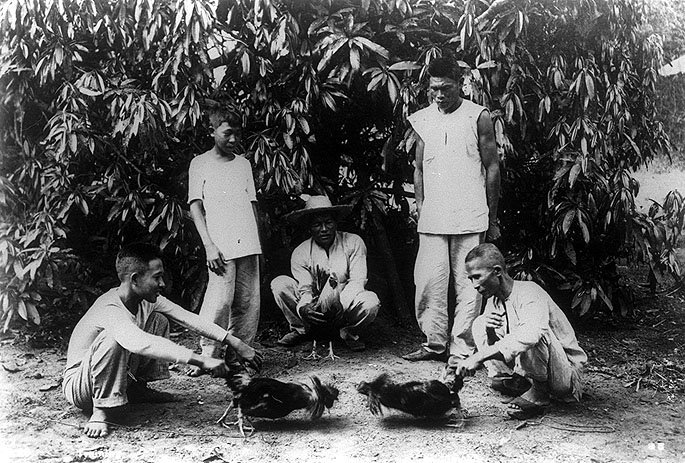
Ilonggos Are Crazy Over Their Cocks


Aside from sugar and aswangs, Western Visayas is also considered the mecca of cockfighting in the Philippines. Although foreigners usually find cockfighting cruel and inhumane, gamefowl breeding is a multi-billion industry in the Philippines and cockfighting remains as one of the country’s three most popular “sports” (the other two being basketball and elections). Every Sunday, one can see cockpit arenas all across the region filled to the rafters as Ilonggos indulge in this most peculiar pastime. It is said that on Sundays, the women go to mass inside the Church while the men go to mass inside the bulangan (Ilonggo for cockpit arena).

Watching a cockfight is an unforgettable experience. Seeing it for the first time, one is astounded by the riotous noise generated by grown men frantically trying to place bets which would put New York Stock Exchange traders to shame. In the middle of the arena, two majestic-looking cocks take center stage to be closely scrutinized by prospective bettors. At the signal of the “christo” (referee), the two avian gladiators are unleashed against each other and the gallery would explode into a deafening roar each time the prizefighters engage in their furious aerial ballet. Once the winner is declared, a hushed silence engulfs the arena while winners and losers settle their business, only for the noise to gradually build up again as the next match draws near.

I am always amazed at how seasoned aficionados could almost always tell, just by looking, which cock is dehado or llamado. It is also astonishing that no one ever runs off on a losing bet considering that bets are made just with hand-gestures and signals. There are still many nuances to the game that I couldn’t quite comprehend like the meaning of hand gestures and how they compute the odds.

As a full-blooded male Ilonggo, I am quite unique because I never acquired a taste for the sport. Back when I was small, I remember going to the cockpit in Leganes, Iloilo during school summer breaks. I went there not to gamble but to help out an uncle who owned the arena. I would help sell food (sandwiches, softdrinks, even chicken barbeque!) and assisted in manning the gate to collect entrance tickets (like in a moviehouse, one has to pay a fee to get in the cockpit). It was like a “summer job” and the money was good because we had the monopoly for selling refreshments inside the arena. But I didn’t like the heat, the dirt, the noise and the brutality of the “sport.” So, eventhough the money was good, I quit my “summer job” and never returned to Leganes.

The Candelaria Fiesta of Jaro, Iloilo held every 1st of February is considered the biggest annual cockfighting event in the country. All the country’s wealthiest cockfighting aficionados and eminent gamefowl breeders gather in Iloilo to participate in that most prestigious event. The late House Speaker Ramon Mitra, an avid cocker, used to fly in his imported cocks in air-conditioned cages. To local cockfighting aficionados, winning the Candelaria Derby is like winning the Masters title in golf.

In Western Visayas as in most areas in the Philippines, cockfighting and politics mix. The region’s most famous breeders are also politicians or are relatives of politicians. Juancho Aguirre, the current president of the Negros Gamefowl Breeders’ Association, used to be mayor of La Carlota City in Negros Occidental. Narciso “Jun” Santiago, who held the “Cocker of the Year” title for several years, is the husband of Senator Miriam Defensor-Santiago. Eminent businessman Jorge Araneta, whose family owns Araneta Coliseum (the venue for most of the big-time cock derbies in Metro Manila), is the brother of Liberal Party matriarch Judy Roxas and an uncle of No. 1 Senator Mar Roxas. There are countless other local breeders who have ties to politicians like Ricoy Palmares who is the elder brother of former Passi Mayor Jesry Palmares. I don’t know exactly why Ilonggo politicians seem predisposed to the game. Probably becuase of the "machoness" of the sport. It could also be because in small towns where there are no local media, one effective way to be visible to voters is to go to the bulangan. Inside, a local politician can gain instant voter recall and acquire a reputation as a winner if his cock wins regularly.

This is not to say that cockfighting is exclusively for the rich because one can see gamecocks practically everywhere in the region, even in crowded squatter areas and far-flung barrios. It is said that breeders spend more time tending their cocks than their children. Ilonggos are just crazy over their cocks.


====

Jo Martinez-Clemente of PDI-Visayas today wrote an interesting piece on cockfighting and gamefowl breeding in Negros titled "A Peek at Bacolod's Other Chicken."