Showing posts with label Books and Movies. Show all posts

Friday, November 03, 2006

Pandanggo sa Ilaw Politics

One good thing about this blog is that it forces me to think of interesting topics to write about daily. Ever since I started this blog about six months ago, I found (to my surprise) that I was capable of writing an entry in it almost everyday. I also find blog-writing easier and more convenient than column-writing primarily because one can just post a link to the item you were writing about for your readers to understand what you were talking about.

Aside from honing my writing skills, another good thing about this blog is that it has induced me to revisit my old books in order to look for something to write about. By now I have amassed quite a collection - well, not enough to start a home library but enough to occupy one side of our wall. When I got married 3 years ago, my wife brought in her own pile of books. Since they are just gathering dust and occupying a lot of space, I thought of giving some away (I will only read it once anyway). But the fact that I spent good money and that I may need them for future reference prevented me from doing so. Now, thanks to this blog I have finally found some use for them. If I cannot think of any topic to write about, I usually turn to my books for ideas (I can also lift entire paragraphs to make my entry look "substantial").

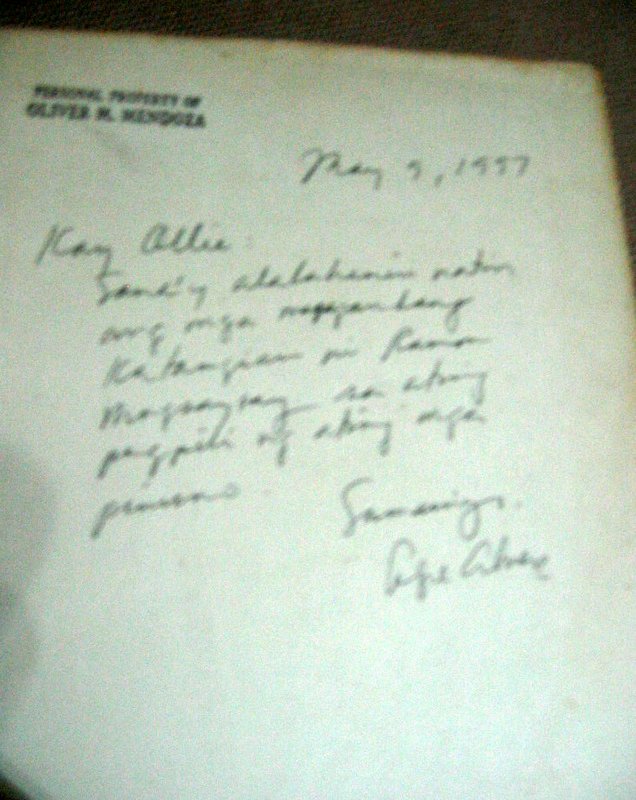
As a political science student, I found that most of the political models we studied in college was incongruent, even irrelevant to the Philippine setting. But the book authored by UP Professor Remegio E. Agpalo sophomorically titled "Adventures in Political Science" has stayed with me through the years. I even had the book authograph by him (I will download photo later).

"Adventures in Political Science" is pretty basic political science stuff but it stands out because of Professor Agpalo's original idea of labelling Philippine politics as "pandanggo sa ilaw" politics. Although the term he coined did not exactly catch on, I thought it was a pretty accurate and colorful description of how politics is practiced in the country then. Excerpts from the book:

"The idea of pandanggo sa ilaw politics is derived from a native folk dance called pandanggo sa ilaw. This folk dance may be described in terms of 1) the participant dancers, 2) the objects the dancers carry or hold, and 3) the way the participants dance. The participants are male or female, two or more of them, who carry lighted glass oil lamps on their heads and the back of their hands. Dancing to the rhythm of lilting music, they sway and balance, go around the stage or dance floor, intermingle, manipulate the glass lamps with amazing and spectacular dexterity, and manuever for dramatic and arresting position on the floor. Agile of hands and nimble of feet, the pandanggo dancers do not trip or drop the glass they carry.

In pandanggo sa ilaw politics, there are elements analogous to those found in the folk dance. Similar to the pandanggo dancers are the political actors --the citizens and government officials; to the glass oil lamps, the power of the political actors. Corresponding to the stage where the pandanggo is danced is the political arena. The movement of the political actors can be compared to those of the pandanggo dancers; these consist in skillful manipulations and manuevering. For this reason, the political actors, like the pandanggo dancers, are fascinating to watch.

Unlike the politics of ideology where the ideological doctrines guide, direct, and dominate the political process, there are no doctrines guiding and directing the political actors in pandanggo sa ilaw politics. Thus, elections, legislations, administration, adjudication, and other processes of the government in this system are not ideology-oriented ... What interests them are personal and practical matters -- what favors can be allocated to supporters and burdens imposed on non-supporters; what personal traits certain public officials or citizens have or do not have; what party can grant favors and what group cannot give patronage; and the like. In other words, pandanggo sa ilaw politics is oriented towards personality, practicality and material goods."

Earlier I said that pandanggo sa ilaw politics is an accurate description of how politics in the Philippines was practiced then. I said "then" because with the way our present crop of politicians fight and slay each other in public, politics today is better termed "Gladiator Politics" rather than pandanggo sa ilaw politics. At least in the olden days, a politician can shine and get noticed by virtue of his intellectual agility and grace of character (just like pandanggo sa ilaw dancers). At kahit mag-kaaway na pulitiko, nag-ngingitian pa noon (well, at least in public) just like pandanggo dancers. Ngayon, nag-ngingitngitan na lang talaga ang mga pulitiko natin (both in private and in public).

Politics has and will always be a spectator sport. But I would much rather watch our leaders do a pandanggo sa ilaw rather that see them slaying each other in public.

Wednesday, October 25, 2006

Movies to Watch

I watched the Martin Scorsese movie "The Departed" and I was blown away. It is seldom nowadays that one gets to watch a movie that "disturbs" and I promise that "The Departed" will really stay with you. I don't want to be a spoiler so I won't reveal the film's plot here. Suffice it to say that it is a good movie with an all-star cast: Jack Nicholson, Leonardio di Caprio, Matt Damon, Martin Sheen, Alec Bladwin and Mark Wahlberg. The acting is not so bad - if you liked di Caprio's acting in "The Beach" (I think he has mastered how to play the troubled, vulnerable youth character) you will like this movie. Also, Matt Damon played his "double-life as a mafia-mole cop" role down to a tee, reminiscent of his acting in "The Talented Mr. Ripley" (I think he has found his acting niche by playing "double-identity" characters). Martin Sheen was perfect as the fatherly police chief and Wahlberg as his badass lieutenant. As for Jack Nicholson, well he is truly menacing and intimidating in the movie. I can say that as a crimelord he is more intimidating in "The Departed" than that Marine Colonel character he played in "A Few Good Men". I think Filipinos will especially like this film and will be able to relate with the movie's "good cop, bad cop" theme.

Another movie I cannot wait to watch is the film about the life of American senator and political icon Robert F. Kennedy entitled "Bobby." I think the simple title is most appropriate to RFK the man. In contrast to his suave brother JFK, RFK was an awkward, taciturn man who often forgot to comb his hair and who wore white socks with his tuxedo. While JFK embodied "effortless grace" (he excelled academically without seemingly studying, got invited to all the right parties, dated all the society debutantes in school and became a celebrated war hero), Bobby had to work hard for his (he was a mediocre student twice kicked out of school, an awkward and self-conscious child who was always insecure about his older siblings' achievements). Even in their choice of wives and family life the brothers are complete opposites: while Jackie Kennedy embodied sophistication (she was treated like American royalty) and became a worldwide fashion icon, Ethel Kennedy was an ultra-religious Catholic who bore RFK a dozen children even when it was no longer fashionable to do so. JFK often kidded his brother that his house "looked like a zoo" with all the litter and ruckus that his brood make. For much of his life, RFK lived in the shadow of his more famous, more intelligent, more "evertyhing" older brother and acted as his political adviser-confidant-campaign manager-punching bag and all-purpose shock absorber. But when his brother was assassinated, Bobby came into his own. Being "disadvantaged" his whole life, he identified with the underdog and developed his own political philosophy which, compared to his brother's and juxtaposed with that "conservative" era, was quite radical. His brand of political activism has inspired and continues to inspire countless people to work for change.

I decided long ago that I liked RFK better than JFK after reading Evan Thomas's book "Robert Kennedy: His Life." Here is an excerpt from the book describing/comparing the tombs of JFK and RFK:

"When Robert had helped design JFK's grave, he had disagreed with his brother's widow. RFK wanted a plain white cross. Jackie desired a grander and more elegant memorial. Today, President Kennedy's grave spouts an eternal flame, and a massive black slab bears his name. On a sweeping curve of marble are carved the heroic words of John F. Kennedy's inaugural address, 'Let the word go forth from this time and place... that the torch has been passed...' Beyond lies the federal city and the great, glistening monuments to Lincoln and Washington.

Robert Kennedy's resting place is to the side, down a narrow alley shielded by some small trees. On a block of marble facing his grave are carved fragments of his two best speeches, his peroration from the Day of Affirmation speech to the South Africans ('Each time a man stands up for an ideal... he sends a tiny ripple of hope...') and the lesson from Aeschylus he delivered in a slum in Indianapolis on the day Martin Luther King was shot ('In our sleep, pain which cannot forget falls drop by drop upon the heart until, in our own despair... comes wisdom...'). A small, plain white cross stands by a stone slab inscribed with his name and the years of his birth and death. In constrast to the grandeur of JFK's grave, the effect is unadorned and a little lonely. One thinks of his struggle to overcome fear and wonders what, if he had lived, he might have done."

Monday, September 04, 2006

"The Devil Wears Prada" is Wickedly Funny

I watched “The Devil Wears Prada” over the weekend. Despite the buzz surrounding the film, I never felt the urge to watch it because I expected it to be just another "chick flick," the nuances of which only fashionistas could appreciate. I was convinced to watch the movie only after a little coaxing from the missus. But to my surprise, I enjoyed "The Devil Wears Prada" immensely.

“The Devil Wears Prada” is a movie adaptation of the bestselling book of the same title written by Laura Weisberger. Since Laura Weisberger used to work as an intern at Vogue Magazine, pundits claim that Miranda (Meryll Streep’s character) is really patterned after Anna Wintour, the iconic editor-in-chief of Vogue Magazine and that the novel is actually a roman a clef of Weisberger's work experience there. When the novel first came out in 2003, it generated a stir in the U.S. fashion industry comparable to the buzz created by the anonymously-written "Primary Colors" in American political circles. In other words, the "Devil Wears Prada" is to fashion what "Primary Colors" is to politics.

Anyway, I enjoyed watching the movie not because of the fashion aspect of it but because I emphatized completely with the character of Anne Hathaway ("Andrea"). I was a fresh college graduate too when I started working for Senator Raul Roco and if you watched the movie, I will say in all honesty that the Andrea character was me. Roco was just as demanding and intellectually intimidating as Miranda, and if anyone asks me now how it was working for the late Senator Roco, I would tell him/her to just go watch "The Devil Wears Prada." The movie completely captures the atmosphere, the stress and the pressures, the highs and lows of working for someone who expects nothing less than the best from his staff. Also, I remember that just like Andrea, my Dad also encouraged me to resign seeing my situation ("the pay is bad, the hours you put in...") but I persisted. I became a "true-believer" and spent the better part of my professional carrer working for the man. I kept telling myself that I am learning many things and that after working for a guy as demanding as Roco, I will be prepared for anything. Aside from the invaluable "training," I also sort of "fooled" myself into believing that great things will happen for me and that employers will be impressed to see that I worked for him. Well, I got "trained" all right but I am still just a struggling, low-ranking, ordinary-salaried employee up to now. Of course, things would have been different if he won. But politics in the Philippines is a "winner-take-all" game and after our second (and most disastrous) stab at the Presidency, I find myself "starting all over again" professionaly.

Now that I no longer work for Roco, some people still cannot totally disassociate me from my former boss. It's like I do not have my own identity; people always see me "as the guy who worked for Roco." I remember that I used to be very careful about expressing my opinion on certain politicians and political matters because I was afraid people might construe it as reflective of Roco's opinion too. When faced with a dilemma, I find myself automatically asking what my former boss would do in a similar situation. Aside from that, I also acquired his taste for biographies and historical books, and I even have my barongs tailored at Philip's, his favorite tailoring shop. We in his staff call it "osmosis." Thank God I did not acquire his taste for flowery shirts.

Back to "The Devil Wears Prada," I strongly recommend you watch it. It is funny and highly entertaining and the clothes are not bad too. Although the plot is rather simple, the movie's visually stunning shots of New York and Paris, and the well-calibrated acting by Meryl Streep (I believe she will win the Oscar for this movie) and Anne Hathaway ("The Devil.." will do for her what "Lost in Translation" did for Scarlett Johannson's career) more than make up for it. "The Devil Wears Prada" is definitely a classic, a movie worth watching over and over again.

Thursday, August 31, 2006

"The Guy" Magsaysay

It was Manolo Quezon (thru his blog) who alerted me about President Magsaysay's birth anniversary, although later he admitted that he inadvertently "advanced" by one day the former President's birthday. Which is just as well, because it prevented me from committing the same mistake (since I was already planning to write about "The Guy" he he...). So now, on the "real birthday" of President Ramon Magsaysay, I would like to share some of my thoughts on the man whom many consider as the greatest President the Philippines ever had.

One of my most treasured possessions is the book "RAMON MAGSAYSAY: A Political Biography" by Jose Abueva. I consider it one of the best-written and most comprehensive biography I have ever read about a Filipino politician. Aside from capturing the true essence of Magsaysay the man, the book also really "transports" the reader back to the political dynamics of the era. I surmise that the book, which was first published in 1971 (by Solidaridad Publishing House), secured the reputation of Professor Abueva as an important political science scholar and eminent writer. I was able to have my copy (which I bought in La Solidaridad Bookstore in Ermita) authographed by Professor Abueva (see photo below). I must have read it at least three times already and (although the photos don't really show it), the book really looks "used" and well-worn, with many side notes, dog-ears and highlighted passages all over.


Ramon Magsaysay lived through very exciting times: born when the Philippines was still an American colony, he saw everything that the Americans built razed to the ground during the Second World War. Gaining fame as a guerilla leader during the war, Magsaysay parlayed his wartime glory into a political career. His rise in politics was meteoric: a Congressman in 1946, Defense Secretary in 1950, President in 1953 - after only just seven years in politics. Truly, Magsaysay's political career is every politicians's wet dream. He defeated the Huk rebellion (with CIA assistance), inspired countless young middle-class professionals to join public service, and truly earned the love of the masa.

Allow me to share a passage from the book. Here, Magsaysay has just recently occupied Malacañang after defeating Quirino convincingly (with a little help from his CIA friends) and Abueva describes the new President's "refreshing" leadership style which is quite a radical departure from how all previous Philippine presidents governed in Malacañang.

"The President's modus operandi was marked by a refreshing informality, a restless mobility, long work hours, direct action, quick decisions, personalized attention, an irritable temper, emphasis on official honesty and zeal, the use of the military, special friendliness with the press, and a consuming effort - underlined by almost daily word and deed - to channel official and citizen interest and resources to the common people. To those who had known him well earlier, these attributes were reminiscent of his drive as defense secretary to woo back to the law the alienated peasantry of Central Luzon and thus to undercut the Huks at their base. Now, as President he would cultivate anew the people's confidence by openly identifying himself with the personal welfare of the common man. He meant to 'bring the government closer to the people.'"

Just as suddenly as when came into the political scene, Magsaysay abruptly died in a plane crash. During his funeral, former President Sergio Osmeña eulogized: "Ramon Magsaysay burst into public life like a fresh wind after a long suffocating day. He died in the night while his people, once more enjoying security and once more full of hope, peacefully slept. They woke up in the morning to discover with a shock and to grieve with a broken heart over their sudden misfortune."

****

Another book which I recently acquired (for free, compliments of the Ateneo School of Government) is "How to Win an Election: Lessons from the Experts" authored by the people behind Newsbreak Magazine. I still have to finish reading it but even now I can say that the book may well become the "Bible" of all political operatives, PR practitioners and aspiring politicians in the Philippines. Using the case study format, "How to Win Elections" reads like a "how-to-do-it-yourself" manual that even the politically uninitiated can easily understand. True to its rather straight-forward title, the book boldly attempts to "de-mystify" elections by systematically analyzing the campaigns of successful and not-so successful election candidates. People aspiring for public office will certainly find the book handy in preparing their respective campaigns. My only negative observation about the book is how they treated the "upset" victory of Isabela Governor Grace Padaca over Faustino "Jun" Dy, Jr. The Padaca article leaves one the impression that it is easy for someone with good intentions to defeat a well-entrenched (not to mention well-armed) dynasty. This misconception might prove fatal for idealistic but naive political aspirants who may try later on to tackle dynastic clans in their respective localities. The book glosses over the important fact that one of the reasons why Padaca won is because she was able to "neutralize" the goons of Dy with the help of the NPAs. In fact, contrary to public perception, it was Jun Dy (and his family) who was constantly under threat of being killed/kidnapped by the NPA during the entire campaign period in Isabela. For this reason, he could not go out and campaign as he wished. Also, on election day, the vaunted political machinery of the former Governor was totally "outclassed" by Catholic Church groups in Isabela while Dy's goons were "checked" by armed elements of the Left. Due to the threat of violence from both camps, the 2004 elections in Isabela had one of the lowest voter turn-out in the province's history. In any case, Grace Padaca deserves her title as a "Giant Killer" and should be rightly considered as a political genius. I just don't want people to have the wrong impression that Padaca's "fairy tale" victory over a well-entrenched dynasty was made possible only thru prayers, idealism and good intentions.

Saturday, August 26, 2006

Is Palparan the Modern-day Col. Valeriano?

The killings of political activists have been going on for several years now and the death toll has been estimated to run into the hundreds. General Jovito Palparan has been accused by Bayan Muna Congressman Satur Ocampo of masterminding the systematic slaughter of left-leaning political activists all over the country. Palparan, of course, denies the accusations and claims that the slain activists were either killed by the NPA or were in fact NPA rebels themselves. Filipinos in general are apathetic and some say already “de-sensitized” by these political killings. And not so many people today know it but the assassinations of leftist activists today have its parallel in the Huk rebel killings perpetuated by the so-called “Nenita Death Squads” of CIA spook Edward Landsdale and PC Colonel Napoleon Valeriano during the 1950s.

Colonel Valeriano and Edward Landsdale both were interesting characters. Valeriano was a distinguished World War II veteran who managed to escape from a Japanese internment camp and hook up with General MacArthur’s forces in Australia while Landsdale was a noted PR/advertising executive in Wall Street before joining the OSS/CIA. He is said to be Graham Greene’s inspiration for his 1955 novel “The Quiet American” and the model for the 1958 novel “Ugly American” by William Lederer and Eugene Burdick. After the Second World War, the two found themselves working together to defeat the Hukbalahap ("Huk") rebellion in the Philippines. Landsdale was then the resident CIA spook in Manila while Valeriano was a promising, young colonel in the Philippine Constabulary. Under the auspices of JUSMAG (Joint U.S. Military Advisory Group), Landsdale created the “Nenita Death Squads” and named Valeriano as his chief "enforcer."

Landsdale practically invented the term “psychological warfare” (psywar) which today has become a necessary component of guerilla and counter-insurgency warfare. And long before the word “salvage” earned its sinister meaning in the Filipino-English lexicon, the Landsdale-Valeriano death squads were already salvaging selected communist cadres in Central Luzon as part of their psywar tactics. And their death squads did not simply kill communist peasants; their murders where imaginatively calculated to sow terror in the hearts of people and demoralize the ranks of Huk rebels. For example, they would play upon the “aswang” myth by snatching a communist rebel at night and draining his body of blood and putting "bite marks" on his neck. The following day, barrio folk would find the body by the roadside and talk would naturally circulate among superstitious people of "aswangs" victimizing people in their town. These “calibrated killings” perpetuated by the Nenita Death Squads were so effective in terrorizing the people and demoralizing the ranks of the communist rebels that then-Defense Secretary Ramon Magsaysay was able to neutralize the Huk-led insurgency in a short period. This “assassination-for-effect” of selected communist rebels and their symphatizers was the first element of the two-pronged strategy of the Magsaysay-Landsdale-Valeriano triumvate designed to defeat the nationalists/communists in a few years.

“The other prong was image-building. The CIA was determined to ensure that the 1951 elections would not be a repeat of 1949, which had been widely seen as a complete travesty of the democratic process. This led to the importing of an early version of a professional spin-doctor in the person of a New York lawyer and PR man named Gabe Kaplan. Under the cover of such CIA fronts as the Asia Foundation, and aided by a team of young Filipino CIA recruits, Kaplan went around the nation’s Rotary Clubs preaching the absolute necessity for free and fair elections. Like Landsdale, he was a character straight out of a novel: a likely model for one of those Sixties’ Ross Thomas heroes like Clinton Shartelle in The Seersucker Whipsaw who were always being sent off by ‘Langley’ to some steamy country to ‘pull a shitty’ in the presidential election. (Thomas had served in the Philippines during the war and retained a keen interest in the country, as his later novel Out on the Rim showed.) Certainly Kaplan was good at his job, and with the middle-class support he was building up all over the Philippines Landsdale and the CIA set up NAMFREL (National Movement for Free Elections), the organization that was to play sich a vital role in the snap election of 1986 and the ousting of the Marcoses. Colonel Valeriano himself was in command of one of the NAMFREL detachments sent to watch the polling in 1951. The outcome was, as intended, a masterpiece of democratic fair play and was prominently billed as such by the US press. The whole election with its appearance of scrupulousness had the equally calculated effect of winning over people of centrist and middle-class politics who had recently been wavering leftwards in sympathy for the Huks and peasants on the receiving end of Nenita tactics.

By 1953 the CIA-Magsaysay alliance was such that the outcome of the November presidential election was guaranteed. The Magsaysay-for-President Movement had been bolstered by the traditional official US blessing of laudatory artcles in Time, Collier’s Magazine and Reader’s Digest about the one man who could maintain American-style democracy in the Philippines. Raul Manglapus (who went on to become Magsaysay’s foreign secretary and, more than three decades later, Cory Aquino’s too) composed a hugely popular ‘Magsaysay Mambo’ to whose catchy beat voters might dance to the polls. The CIA meanwhile had a fallback position in case Quirino’s Liberals resorted to their 1949 tactics of murder and mayhem. They arranged for military compounds and radio stations throughout the country to be occupied by teams of Landsdale’s Filipinos. In addition, a few days before polling began some US destroyers and a small aircraft carrier casually hove up over the horizon and dropped anchor in Manila Bay as a reminder of what might happen unless things went the way Landsdale had organized. It was pure Ross Thomas. Magsaysay won in a landslide.”
(“America’s Boy: The Marcoses of the Philippines” by James Hamilton-Paterson, pages 176-178)

After his successful anti-insurgency campaign in the Philippines, Landsdale returned to America a hero within U.S. intelligence circles and “psywar” became all the rage in Washington D.C. He was later assigned by CIA headquarters to Vietnam and Cuba, which were also beleaguered by insurgents at that time. Using the successful Philippine counterinsurgency campaign as his template, Landsdale proceeded to form death squads to selectively neutralize insurgent leaders while at the same time propping up the image of their local allies through PR and media projection. It is noteworthy to mention that in all his subsequent postings, Landsdale brought with him his trusted Filipino sidekick, Colonel Napoleon Valeriano. Valeriano became the “Luca Brasi” to Landsdale’s “Vito Corleone” and there was a “division of labor” between the two: Landsdale concentrated more on the “glamorous” job of generating support from political leaders and ensuring favorable media coverage while Valeriano carried out the more “nasty” aspects of the mission. In fact, it was Valeriano who trained the group of émigrés who invaded Cuba in what is now known as the “Bay of Pigs” disaster. Who knows what else Valeriano had done for the CIA during his stint there.

To know more about man and the mind of Colonel Valeriano, please read his speech at the Counter-Guerrilla Seminar held in Fort Bragg last 15 June 1961 where he details how the Philippine Constabulary, aided by the Scout Rangers, defeated the Huk insurgency in Central Luzon.

Noting my love for history books, my late boss Senator Raul Roco (who was a wide reader) once told me that: “If you read history long enough, you will find out that everything that is happening today has happened in the past.” And who was it who said: “a people who do not know their history is doomed to repeat the mistakes of the past?”

Friday, August 25, 2006

"Here, Even Maids Have Maids"

Today I am taking a respite from the Petron Oil Spill to talk about this very perceptive social commentary of the Philippines by a foreigner (and an aristocratic foreigner at that). Sir John Mansfield Addis served as Ambassador to the Philippines from 1963 to 1969. Educated at Britain’s most exclusive schools (Rugby and Eton), Addis was a British patrician who fell in love with the Philippines and developed life-long friendships with several Filipinos during his 3-year stint in the country.

Incidentally (since most Filipino bloggers seem preoccupied with this issue), Ambassador Addis was gay and was a good friend of General Hans Menzi, the founder of Manila Bulletin (who was also gay). In fact, Addis during his tour of duty here preferred to stay in the bohemian district of Ermita rather than in snobbish Forbes Park where most diplomats of his rank usually live.

Here he comments about the padrino mentality and the "tyrannical" tendencies of all Filipinos, rich and poor alike. As a foreigner, Addis was surprised to see the prevalence of maids, “boys,” alalays and yayas at all levels of Philippine society (“Here, even maids have maids”). He also found distasteful how even his polite and well-educated Filipino friends would assume “a different air” when dealing with their house-servants and how their servants would assume a posture of “paid deference” and “ingrained obedience” when dealing with their betters. Ambassador Addis said that some "cataclysmic event" or revolution must happen for Philippine society to truly change. So here are some Addis’s observations as written by James Hamilton-Paterson in the book “America’s Boy: The Marcoses and the Philippines.”

“The ‘tyrannical’ behavior he noted is by no means confined to the wealthy elite, however. Nearly everyone in Manila seems to have servants in one form or another. The middle class have servants, and even quite lowly people turn out to have dogsbodies living out at the back somewhere. ‘Here, maids have maids,’ as someone wryly observed, and the padrino mentality extends to the grubbiest urchin boss of a gang of glue-sniffing waifs. The streets of residential subdivisions at seven or eight o’clock at night become a blaring hubbub of car horns as breadwinners return and sit outside, hooting imperiously until some skivvy runs to open the tall, blank metal gates which form the only breach in high cement-block walls topped with barbed wire and broken glass. The idea that any of these white-collar workers might actually get out of his car to walk five yards across the street and ring the bell (or even use his mobile phone) is as ludicrous as the notion that he might consider the peace of the neighborhood. On the contrary, the horn is the naked proclamation of the arriviste, and the more people that hear it the better.

Needless to say, certain people look after their servants exceedingly well, with thoughtfulness and civility, but they tend to be the ‘older’ families. They very often have strong links to a particular province, so the servants will tend to come from the same village or neighboring town, all speaking the same dialect and with constant news of home. Usually the family will ensure that such long-term retainers will have a house to retire to on their provincial estate and that their children will have an education and are decently looked after. This, of course, is what paternalism properly is. Exactly the same system was once common among more enlightened families in Europe, until it was virtually ended by the First World War. The interesting thing is that there still has not been a ‘First World War’ in the Philippines, in the sense of a cataclysmic event that overturns an entire social order. The Second World War was cataclysmic indeed, but it did not radically change overall social relationships. Some now think that, in default of revolution, the class structure will simply erode gradually and patchily under the democratizing influences of urbanization, mobility and increasing financial independence.

The Filipino elite is a fascinating mixture of ‘old’ money and new, and delicate snobberies still exist between the two. The phrase ‘Manila 400’ was taken to refer to the little principalia class of intermarried families who effectively owned and ran the entire country. This dated phrase has been widely misunderstood as literally meaning four hundred families, whereas it is simply an expression of an exclusive social set. It was originally supposed to have referred to the number of people who could fit into Caroline Astor’s ballroom at the end of the century.”

Wednesday, August 16, 2006

The Myth of the “Omnicompetent Citizen”

For quite some time now, I have been quietly observing the ongoing “debate” between adherents of One Voice and Sigaw ng Bayan. It seems to me that the two groups have reduced the Charter Change debate into only one issue: whether or not the Filipino people should continue having the right to vote for President. One Voice tends to hew closely to the “Vox Populi, Vox Dei” (The voice of the people is the voice of God) view and they oppose a shift to a parliamentary form of government because it will take away the people’s right to vote for president. Sigaw ng Bayan, on the other hand, wants a shift to the parliamentary system that would result in only members of Parliament choosing who gets to head our government. Given the people’s history of electing actors to national office, Sigaw ng Bayan feels that members of Congress are the ones most capable of knowing who is most qualified to rule our country.

The more important question now then is: “Can the people be trusted to vote for the best leader?” Or, put another way, “Are the people competent enough to know who is the best candidate in the ballot?”

Legendary journalist Walter Lippman, in his seminal book “Public Opinion,” has already debunked the theory of the “omnicompetent” or the all-knowing citizen. Written sometime in the 1920s, “Public Opinion” has since become required reading for all political scientists, opinion makers and journalists worldwide. In his classic book, Lippman posited that the general public’s view of reality is incomplete, that is, they do not see what is really going on in their government aside from what they see on TV, read in the papers or hear from the rumor mills. He also said that public opinion can be easily manipulated by propaganda and that people’s attitudes are heavily influenced by stereotypes. And since the public is not “omnicompetent” and is in fact easily susceptible to propaganda and stereotypes, Lippman concluded that governments should not wholly trust their citizens to know the “objective truth.” Citizens, he claimed, are not competent to know what is best for them because they are not well-informed enough to make correct decisions on multifaceted issues and intricate policy matters.

Applying Lippman’s theory in the Philippine setting, one tends to agree. Take the case of the Filipinos past choices for President. In the 1992 presidential elections, then-Senate President Jovy Salonga arguably was the most qualified of the candidates. But people did not vote for him because they thought he was old, sickly and was about to die soon (Salonga is still alive today and in fact, still writes articles). If the public was “omnicompetent,” they would have known Salonga would not die. Also, most Ilonggos then voted for Miriam Santiago simply because she is their fellow Ilonggo, one example of how “stereotypes” influence public opinion.

Taking my argument further, if people were all-knowing, they would have clamored for Washington Sycip to be their President (I believe Wash Sycip is the best person alive to manage our economy). Congressman Miniong Teves (who is still one of our hardest-working and competent legislators despite his advanced age) would already be a senator. And Butch Africa (the guy who modernized the National Statistics Office) would be a COMELEC commissioner by now. But it seems to me that our current system does not allow these outstanding individuals to rise to important positions of leadership. And I am referring not only to their inability to get elected. I am also referring to the media's failure to herald their achievements and make them "celebrities" to the public. I also mean the failure of powerful interest groups and political parties to recruit these outstanding individuals to vie and win public office. It is clear then that our "selection process" for our leaders is flawed and limiting.

Of course, there are people who will argue that the solution is not to change the form of government but to educate our people. But I am sure that there are masteral or even law graduates out there who do not know who Wash Sycip is or what Butch Africa has done to turn around NSO from being one of the most inefficient government agencies to one of the best-performing today. This seems to prove Walter Lippman’s point that people are not in the best position to know the “objective truth” because they are limited by incomplete information, stereotypes and propaganda. Based on their track records, these three individuals I mentioned are eminently qualified to run our government, but why is it that only a few Filipinos know that they even exist? And even if these three run for office, I am sure they will lose because aside from being “unpopular,” they lack resources, name-recall, party machinery and mass appeal.

So where does that leave us? I believe that by shifting to a parliamentary form of government, our people will have a bigger chance of choosing the best and the brightest leaders to run our country. Under the parliamentary system, talented individuals with no political pedigree or financial resources would have a better chance in getting elected because it will be the party which will choose their candidates and shoulder their campaign expenses. Once in Parliament, an extraordinarily-gifted but relatively "unknown" individual can shine and earn the respect of his peers, and hopefully merit their votes when they choose the Prime Minister. It will also prevent incompetent individuals who are merely riding on their star quality from capturing high government posts. It will also force our people, who are easily “awed” by a familiar political name, to take a second look at “fresher” political faces and this will hopefully lead to the infusion of “new blood” to our already incestuous political system. I also believe that the provinces will have a better chance to develop if we change our system into a parliamentary-federal form of government. For these reasons, I am in favor to a shift from the presidential to the parliamentary system.

Monday, August 14, 2006

On The Preponderance of the Pinoy Elite

After discussing the tragedy of the Filipino middle class (see my earlier entry), allow me now to examine some of the reasons behind the preponderance of the Filipino elite class in electoral politics. I have always been fascinated on why and how the traditional elite have somehow managed to sustain their grip on political power despite the fact that many of them have already lost their preeminence in Philippine business. The world of business today is very much different from what it was 50 years ago; for example, most of the old elite (i.e. Sorianos, Elizaldes, Madrigals, Cojuangcos, etc.) have already been dislodged by the new (i.e. Gokongweis, Sys and Lucio Tan, etc.). Scanning the list of elected officials today, one finds the same family names occupying high government posts. One can therefore conclude that although they lack entrepreneurial flair, the elite more than makes up for this by displaying remarkable aptitude for politics.

I find the Filipino elite’s “staying power” in politics truly remarkable, especially in light of their “spotty” record in history. Because unlike the elite in other countries who truly contributed to making their countries great, the history of our local elite is marked by their collaboration, putting personal over public interest and failure to make our country great. The British aristocracy for example, has provided exceptional leadership that enabled their country to become one of the largest empires in history. Whether as outstanding ship captains during the Napoleonic Wars, able administrators of their colonies, or as gallant officers during the two World Wars, the sons and daughters of their elite proved they deserved their respected position in English society. Armed with little more than an Eton education, young members of the British aristocracy would go off to colonize distant lands and develop new markets for British products by befriending local elites (i.e Nicholas Loney).

In contrast, the Filipino elite as a class has no “generational achievement” to boast of and in fact, the history of the Pinoy elite is marked by their failure to lift our country to greatness. Of course, many of them fought and led our revolution against Spain and America but they were also, as a class, the first ones to pledge allegiance to our colonizers. During colonial times, most of them acted as the trusted administrators of our colonizers and helped in their subjugation of rebellious Filipinos. After the Philippine won her independence, the elite failed to develop our manufacturing industry and concentrated mostly in real estate development, rent-seeking and extractive industries which had turned the Philippines into the consumerist society it is today. In the field of public governance, they have (and continue to) mismanage our government such that the Philippines is now saddled with P4 trillion in foreign debt. Today, corruption and mediocre governance is the norm in government service.

Taken from this historical perspective, it is fascinating to see how ordinary Filipinos continue to be “mesmerized” by the elite and continue to elect them to public office. Given their “spotty” record in history, one would think that Filipinos would reject “old” families and clamor for “new blood” in politics. Many political pundits say that the preponderance of local elites is attributable to their monopoly of the “guns, goons and gold” (and in addition, “girls” meaning sexy showbiz dancers). But I somehow find it hard to believe that our people can be cowed / controlled by “guns, goons and gold” for so long, especially in this age of mass media, internet and universal education. There must be something more to it than just their ability to terrorize and buy votes.

It is said that political leaders embody the people’s aspirations and that people elect as their leader someone whom they think personifies their aspirations best. Be it good looks, intellect, success in business or profession, or talent, a leader possesses something which people want or aspires to. Of course, seeing the quality of our current crop of leaders leaves this theory in doubt. But the fact is, the masa aspires to become the elite. For example, the masa wants to wear what the rich wear (hence the popularity of fake LaCoste shirts), they want to go where the rich go (everyone wants to go to Boracay), they want all the things that the elite have (a big house, a nice car, an expensive education, etc.). And finding that they cannot achieve those aspirations here, the masa migrate abroad to earn dollars just to be able to imitate the lifestyles and mannerisms of the Filipino elite.

The Filipino’s adulation for all things elite, I think, has a profound effect on how we choose our leaders come election time. For starters, Ilonggo voters have a penchant for measuring a politician’s worth by how thick his wallet is and how “galante” he is to his constituents. Having a familiar, prominent-sounding last name also helps. Also, descendants of prominent politicians have a built-in advantage because of the "goodwill" their ancestors have built for them. Which is I guess par for the course: a good lawyer or doctor would be leaving behind a large number of satisfied customers whom his son or daughter can inherit later on. This, I think, is another plausible explanation for the preponderance of the Filipino elite in Philippine politics.

Thursday, August 10, 2006

The Tragedy of the Pinoy Middle-Class

While most media outlets chose to highlight Pulse Asia's findings showing that 3 out of 10 Filipinos would choose to migrate abroad, I would like to discuss their other major finding showing that 82% of Filipinos acknowledge oligarchic hegemony in Philippine politics. In their latest July 2006 survey, Pulse Asia found that 41% of those surveyed say that the Philippines is controlled by a powerful few and ordinary citizens cannot do anything about this situation. They also found that "an equal number of people (41%) is unable to agree or disagree with this view and vacillates regarding the existence of oligarchic rule. Belief that a powerful few runs the country is strongest in Metro Manila (55%) and weakest in the Visayas (35%). Levels of public indecision, on the other hand, are generally constant across the country’s geographic areas and socioeconomic classes. The rest of the nation – a rather small proportion at 17% -- disagree that the country is controlled by a powerful few."

This fact that the Philippines is being ruled by the "well-born" is already old news to most Filipinos, although most may not have a concrete idea why this is so. So allow me, as someone who experienced up close the inner workings and internal dynamics in our political parties, amplify on this "oligarchy rule" phenomenon.

Under the current Philippine political set-up, a person with no "political pedigree" and resources (like me for example) has no chance of getting elected in Congress. Just to run for Congress, one needs to personally raise at least P15 million for his "warchest." And P15 million is just the bare minimum. It still would not ensure a congressional aspirant a convincing electoral victory. Running for public office therefore, remains a rich man's world. It always has been and it looks like it will always be that way.

Descendants of prominent politicians have a built-in advantage because of the "goodwill" their ancestors have built for them and in terms of name-recall. Which is I guess par for the course: a good lawyer or doctor would be leaving a large number of satisfied "customers" whom a son or daughter who decide to take up law or medicine can inherit later on. But Filipinos are different because they are easily awed by a familiar political name. People nowadays do not really examine a politician's credentials or listen to their platforms and policy advocacies. Speeches are dismissed as empty rhetoric and candidates can make a better crowd impression by dancing or singing on stage (Pinoys, being a musical people, put a high premium on a good singing voice). Nor are people impressed by academic credentials and sophistry anymore. Nowadays, in order to generate "goodwill" and make people take you seriously, one has to spend money on projects (medical missions, goodies and dole outs) and/or PR.

So what can a politically ambitious young man without a "political family name," financial resources and network do to become a congressman? The easiest route, if one has the looks, talent and brains, is to become a celebrity: a movie star or a newscaster. One can also join Akbayan or Bayan Muna or any of the party list groups. But not everyone is blessed with good looks, a deep TV/radio voice or a nice singing voice. Also, joining the Akbayan or Bayan Muna is problematic because they pretty much have an established seniority list and besides, one would have at least been jailed by Marcos to become a senior party member.

The usual route taken by persons harboring political ambitions is to join the "mainstream" political parties like LAKAS, NPC, LDP or the Liberal Party and become an active and loyal party member. By campaigning and making oneself "available" during elections, a person can earn "pogi" points with party elders. If the party candidate wins, one can get appointed to a government post that one can use as a "platform" for his own media projection and "fund-raising" activities. Of course, since government positions are limited, not all campaign workers can be granted a post. And it should be pointed out that government appointments are not just handed out to anybody like candy: one has to do something "extraordinary" to get noticed by a politician enough to merit a lucrative government posting. Most of the time, party operatives are largely left to themselves after elections, to be "reactivated" one year before elections. In the interim, party members find work elsewhere as private sector employees, small-time businessmen, or worse as influence-peddlers.

In other countries, a loyal party man can rise through the ranks and eventually get nominated to a party seat in Congress if he plays his cards right. In our country, one has to get elected congressman FIRST before he can become a high-ranking party official and not the other way around. Under the current Philippine party set-up, the chances of someone without pedigree and money getting nominated to Congress is practically nil. I have yet to hear of a loyal, long-serving party man or a simple political officer who was funded and supported by a party to Congress. The only political operatives I know who have managed to get themselves elected were the children of politicians themselves and their election is more because of their family’s resources than their party’s backing.

Of course, many poor but talented individuals get elected as councilors and even as provincial board members. Some exceptionally talented ones even get elected as mayors and governors. But by far, becoming a mayor or governor is very difficult for Filipinos with no money and pedigree and those who do succeed are more the exception than the rule.

Some Charter Change advocates have used this as an argument in changing our form of government from presidential to parliamentary. They argue that under the parliamentary system, ordinary citizens will have a greater chance of rising in the system. Political parties will also have a bigger chance of becoming “professionalized.” Under this system, talented party members who have no political pedigree or financial resources would supposedly have a better chance of landing a government post because it is the party who will choose and shoulder their campaign expenses.

The current political system in the Philippines is not only oligarchic but has also become incestuous, what with the well-born marrying into each other (read the book "The Ties That Bind"). The Filipino middle-class, whom people look up to to provide reform-oriented leadership and "new blood," has become silent and inward-looking. Many choose not to become directly involved in politics, choosing to fund a scholarship foundation here, a feeding program there, and so on. Of course, there are many gifted and qualified middle-class professionals out there who would love to become Congressmen. But the problem is that they neither have the money (or if they do, they would rather spend their hard-earned money on themselves) nor the inclination for the rough-and-tumble of politics. In fact, just the thought of singing and dancing for complete strangers puts them off. The irony of it all is that the political elite never seems to have qualms about "humiliating" themselves in front of the public. As my friend who is a mayor once said, "it is easy for these sosyal, civil-society types to bitch about what is wrong in our country but they themselves do not have the guts to put their names on a ballot."

The sad thing about the Filipino middle-class is that they know very well what is wrong and what should be done to correct the ills of our country but they choose to withdraw in their enclaves or migrate to Sydney, New Jersey or Toronto. This, to me, is the tragedy of the Pinoy middle class (to borrow a line from the movie "Havana").

Friday, June 23, 2006

Memoirs of an Expat

While surfing the internet, I chanced upon a book about two brothers of Swiss nationality who worked in the Western Visayas region from 1919 to 1935. Entitled “Meine Lieben: Swiss Letters from the Philippines,” the book was published jointly by the Ayala Foundation, Inc. and Filipinas Heritage Foundation. For a limited period, the Ayala Foundation permits internet browsers to download the book. The book is a collection of letters written by the two Swiss brothers about their thoughts and impressions about Ilonggo society in the 1920s-30s.

The older brother, Albert Irminger, worked as an employee of A.C. Lutz & Co. (later Lutz & Zuellig and then F.E. Zuellig, Inc.), a Swiss trading firm operating in Manila and Iloilo City at that time. Albert arrived in Manila from Zurich in 1919 and was assigned by his company to its Iloilo City branch a year later. His younger brother, Hans Irminger, arrived in 1920 and worked as a sugar plantation manager (encargado) for Walti & Hablutzel & Co., a Swiss company which owns several sugarcane plantations in Negros Occidental. Hans managed two plantations for his employers, Hacienda Canlaon and Hacienda Camansi located near Kabankalan.

In present-day terms, the two would be called expats – foreign professionals who work and manage businesses in the Philippines. The two brothers are unique because they worked in different environments: one worked in the city while the other on a farm. Thus, their letters give us a comprehensive picture of what life in pre-War Philippines was like both in the urban and rural areas of the country. Below is a letter written by Albert Irminger to his parents describing conditions in the offices of A.C Lutz & Co. in Iloilo City:

“In the office we worked very differently than at home: (1) more autonomously and (2) I don’t have to work on the typewriter – which pleases me very much. We have double the number of Filipinos than Whites for general office work, correspondence and bookkeeping. The Chief Bookkeeper, a Filipino, earns more than we ‘on our first contract,’ but he is subordinated to the Cashier, a 23-year old Swiss. Most Filipinos worked for a very low salary and can just the same maintain their families. Recently, one of them who earns not quite one-fifth of my salary, got married! One must of course take into account that we Europeans need much more money to be able to live comfortably in this climate.” - Albert Irminger, December 30, 1919

Albert’s starting salary or ‘first contract’ was 260 pesos plus 30 pesos cost-of-living allowance, quite a considerable sum during those days. His younger brother Hans sent this letter to their parents to describe his first year working as an encargado in Negros:

“You at home, and even in Manila and Iloilo, have no real idea of how life and work on a sugarcane hacienda are. Even Mr. Walti (the hacienda owner and employer) is not well-informed. His place of work is at the office. One or two visits a year (to the plantation) do not permit one to see and observe all. So it is understandable that much of what he told me or recommended, is false or even contrary to the facts. The patterns of behavior he recommended may be right for a boss, but not for me. I’m still far from being a boss – rather just a beginner. He told me for example that under no circumstances should a White man do physical work, or he will lose his authority over the Indigenous. Yes, this may have been so, once upon a time, under Spanish authority, but now the Americans are the supervisors of the country…This is now very different. If a task for whatever reason doesn’t progress as it should, one intervenes, helps here, helps there. Mr. Walti even said, I shouldn’t think that I have to drive the tractor. But if I understood the machine, I would do it even today….” - Hans Irminger, January 9, 1921

In his first letter to home, Hans could not quite reconcile with the idea that he is not supposed to do manual work and would have wanted very much to operate the farm tractor if he only knew how. Two years later, we read a much different Hans, bolder and more confident, a far cry from the tentative, newly-arrived encargado two years ago:

“I am really having a good time. I am always healthy and in good humor. My independent work pleases me very much, although I could have grey hair in spite of my 24 years due to much anger with the Filipinos. During the harvest I am responsible for about 150 workmen. As I am the only White on the hacienda, I am a kind of a small king in my kingdom. It is really a pity that nobody can take a picture of me – without my knowing. This might produce some quite interesting pictures, for example when I chase through the fields with my horse, the small felt hat somewhat oblique on my head, and wearing khaki shirt and khaki pants…Looking at such pictures you would probably believe that I am in the Wild West rather than in the Philippines…” - Hans Irminger, October 24, 1923

Europe in the 1920s and 1930s was marked by periodic political and economic instability. Faced with limited employment prospects at home, young European professionals like the Irminger brothers have to leave their homelands for greener pastures abroad. The opening of the port of Iloilo to international trade in 1855, the opening of the Suez Canal in 1869, advancements in steam navigation and increasing world demand for sugar facilitated the growth of the sugar export trade in Western Visayas. And foreign trading firms like Ker & Co., Loney & Co., etc. played a vital part in providing the local sugar industry with credit and technology. By the early 1900s, Iloilo City was a thriving port city and many foreign businessmen were attracted to its lucrative sugar trade.

When he first arrived in Iloilo City to work for A.C. Lutz & Co., Albert Irminger was pleasantly surprised to find a large expatriate community there. Iloilo even had a Swiss Club and Albert would spend most of his free time relaxing in the company of his countrymen. In contrast to the civilization of Iloilo, his younger brother Hans discovered a backward, frontier town in Negros. Hans had to live in a simple hut (bahay kubo) and had to go to Iloilo City regularly to buy personal supplies, farm machineries, etc. He even had to go to Iloilo City in order to watch a movie or see a dentist. Below is Albert Irminger’s letter to his parents in Switzerland dated December 28, 1919 describing the general conditions in the Philippines at that time:

“…The national costume of ladies consists of a long dress reaching down to the feet and a type of starched blouse which leaves necks and shoulders free. One encounters here few women in European dress, and if one does, then they are young girls. Older Filipino women often still smoke cigars – which seems strange to us – and cigarettes which they stick with the burning part into their mouths. Men are dressed European style, mostly very elegantly, but on the other hand they live in a ‘stable’ and eat nothing but rice. Therefore they have little resistance to illnesses and die away like flies. One wonders that not more illnesses break out due to the incredible dirt in which they live in the many suburbs. Their huts sometimes stand on stinking quagmire.

Filipinos are in general musically gifted. There are excellent music bands which would be even better if they could afford more expensive instruments. Speed control of too fast drivers is very efficient. All day long some official motorcyclists chase so-called speeders, overtake and bill them if they drive faster than permitted. The first time, one gets an expensive fine; if repeated a prison sentence! Such a useful institution would also suit Switzerland! The traffic system of trams, cars, and other vehicles work perfectly.

As you know, the Filipinos would like to be independent. But it would be stupid of the USA to fulfill this wish, because they are as yet absolutely incapable of governing themselves. They have some freedom in internal affairs. Many Filipinos are employed in the administration, and they have their own Parliament. But they still need the guiding hand of a civilized people. There still half-wild tribes living in the center (interior?). Young Filipinos delight in military training, but look quite ridiculous with their wooden guns. They don’t succeed in looking smart. Our schoolboys at home do this better and with more seriousness…”

His younger brother Hans sent their parents this letter dated June 29, 1924 from Hacienda Camansi in Negros Occidental:

“In Ma-ao we visited a fairly modern hacienda, whose proprietor was a Filipino. There are intelligent guys among them. There is an interesting difference between the haciendas Camansi, La Carlota, La Castellana, Canlaon and the one in Ma-ao. In the first four haciendas, most of the hacienderos are Whites, foreigners. While the majority of the Whites work well and economize in order to be able to take much money back home, i.e. they have beautiful fields and primitive houses, the hacienderos of Ma-ao, all Filipinos, on the contrary don’t work well, have bad sugarcane, many weeds in the fields, but lead a grandiose life. They build the nicest houses on their haciendas, buy cars, enjoy all kinds of comforts and – most importantly – they have debts up to their necks. But, after all, they are living in their own country…”

Albert Irminger returned to Switzerland in 1928 to continue his business career. His last visit to the Philippines was in 1953. He died on September 30, 1979. His younger brother, Hans Irminger, stayed on to managed several sugar plantations for the Philippine National Bank. Sensing the possibility of a Japanese invasion of the Philippines, he left the country in 1935. Hans worked as an employee of Suarer AG, a trucking company in Arbon, Switzerland until his retirement. He died on July 24, 1973. In 1997, his daughter, Lisa Ammann-Irminger, discovered their letters and photos of the Philippines and presented these to the Ayala Foundation for publication.

Wednesday, June 07, 2006

Recommended Reading for Pundits

Former Rizal Congressman Gilberto "Bibit" Duavit has come out with a book - "WAYWARD POLITICS: Revolutions and Constitutions" - a firsthand account of the 1972 Constitutional Commission.
I didn't really thought of Congressman Duavit as a writer (he's known more as a single handicapper in golf) but I was really surprised on how well-written WAYWARD POLITICS is. His book is both funny and very informative - an easy read. And it is not preachy - Duavit recalls the ConCom with an amoral eye. I recommend it to all political scientists, pundits and students of history.

Sunday, June 04, 2006

Manolo Quezon's "I am a Bootlicker" Essay

Ever read a book whose words really hit you? Or maybe a movie whose dialogue continually haunt you? For lovers of the written word, I recommend this gem of an essay written by Manolo Quezon entitled "I am a Bootlicker." Funny, witty, candid and most of all, true. (As a PR practitioner myself I should know). The best I have read in quite a long time. Read it here.

Friday, May 26, 2006

More on the Da Vinci Code Controversy

I don't know why so many so-called "Filipino church leaders" and moralists are making a big fuss over the showing of Da Vinci Code in theaters. As a novelist, Dan Brown only did to religious history what Michael Crichton did to science and technology: which was to make an otherwise boring topic more interesting to readers.

Sunday, May 21, 2006

"Da Vinci Code" (the Movie) A Major Disappointment

I read the book a couple of years ago and watched the movie only last Friday. The movie was a big disappointment and it failed miserably to do justice to the book. The movie totally missed out on the book's major point - Dan Brown’s book is primarily about women’s rights and women empowerment: how Christianity squelched the original role of women (the Sacred Feminine) as important and co-equal members of society. The movie failed to convey this message but instead concentrated on the more controversial myths involving Mary Magdalene, Opus Dei and the Knights Templar. Nevertheless, people who haven’t read the book would probably enjoy the movie.

In pre-Hispanic Philippines, animism was the religion generally practiced by natives and women-priests called babaylanes administered the faith. While the datu (warrior-king) wielded military and political power in the barangay, the babaylan (priestess) complemented him by overseeing the health and spiritual needs of the people. When the Spanish friars came, they eradicated animism and persecuted babaylanes as witches and devil-worshippers. Even today, the Church and the general public frown on strong and independent-minded women, often labeling them as harlots and seductresses.

Wednesday, May 17, 2006

Da Vinci Code Fever!

The movie adaptation of the bestselling book, the Da Vinci Code, will be shown in local theaters sometime next week. The book, which was written by controversial novelist Dan Brown, has already sold 50 million copies worldwide and has spawned a whole literature of books on Catholic conspiracy theories and “alternative” versions of Christianity. The movie adaptation, which was produced at a budget of $125 million, promises to be a worldwide blockbuster just like the book. I read the book a couple of years ago and I could not wait to watch the movie to see if it will live up to the book. I will refrain from discussing the Da Vinci Code’s plot so as not to spoil the fun for those who haven’t yet read the book.

I have always been curious about the histories of religions and conspiracy theories involving the Catholic Church ever since I read the book “Holy Blood, Holy Grail” sometime in the late 1980s. I recall that I had to wait for my father, who was also an avid reader, to finish reading the book and he would tell me snippets of information concerning the author’s theories about the Knights Templar, Mary Magdalene and her supposed marriage to Jesus Christ. When I finally got to grab the “Holy Blood, Holy Grail” from my father, I was disappointed with the book author’s verbose prose and undulated style of writing. It was really very hard to read.

Most of the theories presented by Dan Brown in the “Da Vinci Code” are nothing new. Most of it you can read in the “Holy Blood, Holy Grail.” But the genius of Dan Brown lies with the way he weaved the different information available in a way that readers found entertaining to read. Although his book ultimately questions many basic beliefs of Christianity, what really grabs me is his effortless way of mixing art, religion and crime into a fictional novel.

The movie version of the “Da Vinci Code” is just one of several “setbacks” that the Roman Catholic Church has suffered in recent times. The “Da Vinci Code” was first published in 2003 and it caused worldwide consternation among conservative Christians. Then in April 2005, the whole world was jolted when Pope John Paul II passed away. Pope John Paul II, the first non-Italian and one of the longest-serving popes in recent history, was universally loved and respected by Catholics and non-Catholics alike. The new pope, Pope Benedict XVI, openly admitted that it would be very hard for him to fill the vacuum left by Pope Paul II’s death. Certain quarters in the Catholic Church hierarchy are concerned over the new pope’s perceived “ultra-conservatism.” Just recently, the Vatican’s move to ban the holding of hands during the “Our Father” and strict adherence to Catholic dogmas elicited some consternation to some Catholics here in the Philippines. Here in the Philippines, Gaudencio Cardinal Rosales, the archbishop of Manila has denounced the book as blasphemous, but stopped short of calling for a ban.

Then just recently, National Geographic announced their discovery of the “Gospel of Judas” in Egypt. Said to be written around 300 AD, the “Gospel of Judas” would make us believe that Judas was actually the greatest of all the disciples because, with his betrayal of Jesus, he caused the crucifixion and ultimately the salvation of man. The said Gospel quotes Jesus saying to Judas: “you will exceed all of them (the disciples), for you will sacrifice the man that clothes me.” Religious scholars now believe that there were initially more than 30 Gospels in the Bible and not only four (Matthew, Mark, Luke and John) and that the early Roman Catholic Church eradicated these other “gospels” to impose a simpler, more “standardized” Christian canon.

How should a Christian deal with all these emerging information?

I believe that all these information coming out will ultimately be good for the Christian faith. “Non-religious” people are again talking and debating about Christian doctrines whereas before, only Bro. Eli Soriano, the Iglesia ni Cristo and other fundamentalist sects are heard keenly discussing religious doctrines. I believe that you have to constantly challenge and question your beliefs for your faith to be truly meaningful. Faith untested is shallow. Ordinary Christians must therefore analyze critically these new information and decide for themselves whether to believe it or not. Church leaders cannot and must not dissuade their flock to explore these new information coming out, for God values faith rooted in informed choice more than religious belief based solely on ignorance and blind obedience.

Tuesday, May 16, 2006

The Great Ilonggo Novel

As a teenager, I always dreamt of writing the “Great Ilonggo novel.” A novel about growing up in Ilonggo society that is so exquisitely written and painfully honest that it would remain in the hearts of readers forever. My models then were J.D. Salinger, author of “Catcher in the Rye” and F. Scott Fitzgerald, author of “The Great Gatsby.” These two classics, which delved into the hypocrisies of New York the high society and the treacheries of the Eastern seaboard elite, made a deep impact on me when I was a teenager and I resolved to write a similar novel about the travails and joys of growing up in Western Visayas.

Apparently, someone has beaten me to the draw. He is Vicente Garcia Groyon. And the book is “The Sky Over Dimas” (De La Salle University Press, Inc., 2003). What gets my goat is that Groyon is not even an Ilonggo but grew up in Quezon City. Another irritating fact is that he is a LaSalista. But that aside, the “Sky Over Dimas” is one good book, arguably the best fictional novel ever written about Ilonggo society. The novel, which chronicles the lives of a dysfunctional haciendero family in Negros, is both funny and moving. I will let eminent writer Alfred Yuson describe the book for you since I could not word it better than him: “Groyon’s familiarity with the Bacolod matrix of manners – surreally rich scions, weird personalities, outrageously decadent lifestyles – has endowed him with the rich material to mine and /or undermine for his fiction. The Sky Over Dimas reads exceedingly well, with its stylized construction serving the clear and illuminating prose as fine form perfectly following fluid function. It is clearly a worthy addition to the ranks of Filipino novels in English.” The book won the grand prize for the Don Carlos Palanca Award for Literature.

If only I didn’t play computer games as much and worry about having to earn a salary for my family, I would have probably written a better book. That is why I am excited to learn that a bill was recently passed in Congress that would grant financial assistance to aspiring book authors. The measure, which was authored by Iloilo City Congressman Raul Gonzalez, Jr., is a brainchild of his younger brother, Dr. Dennis Gonzalez, who is currently Chairman of the National Book Development Board. The “Brothers Gonzalez“ shepherded the bill thru the House of Representatives and are now lobbying for its passage in the Senate.

Book readership, especially among the young, is declining in the country. TV and radio has replaced newspapers as the main sources of news and information. Browsing around Iloilo City’s bookstores, one would notice a dearth of local books. These are the conditions which the bill hopes to address when it is enacted into law. By giving incentives to book writers, effectively freeing them from the day-to-day concern of earning for their family, more aspiring writers will be encouraged to take sabbaticals from their regular jobs and write their novels.

Wednesday, May 10, 2006

12 Little Things Every Filipino Can Do To Help Our Country According to Alex Lacson

One fellow Ilonggo is quietly influencing attitudes and inspiring countless Filipinos to do more for their country. Atty. Alex Lacson, who hails from Kabankalan, Negros Occidental, has surprised pundits and book authors with the success of his book titled “12 Little Things Every Filipino Can Do To Help Our Country.” In just 8 weeks, “12 Little Things” has sold 2,000 copies and has since been reprinted several times.

I had the privilege of knowing and working with Alex Lacson last year. Even before he achieved nationwide acclaim, Alex was already a celebrity in his hometown. In fact, he was being pushed by civic and youth groups to run as congressmen for the 6th District of Negros Occidental to replace Congressman Lim-ao Alvarez, who was already on his third term, but he declined. I guess he was too decent to enter the rough and tumble world of politics.

Lacson consistently excelled in school. He first studied at the Philippine Military Academy but feeling that military life was not for him enrolled at the University of the Philippines College of Law, graduating in 1996. What strikes me most about Alex is his humility and idealism. His is not the “in-your-face” type of patriotism which we commonly see among leftists and activists that puts people off. Soft-spoken and self-effacing, Alex wins you over with his sincerity and his courage to live by his personal convictions - a true southern gentleman.

"12 Little Things" is a practical and do-able guide for Filipinos who are overwhelmed or do not know what to do in the face of the current situation in our country. The book challenges us Filipinos, especially those who complain about everything, to show our love for country not only thru words but deeds. Anyways, here are the 12 little things every Filipino can so to help our country according to Atty. Alex Lacson (italics mine):

1. Follow traffic rules. “Sundon ang layi trapiko.” Indi mag-jaywalking, indi mag-singit, indi mag-over speeding.
2. Whenever you buy or pay for anything, always ask for an official receipt. “Pangayu-on pirmi ang resibo.” Para maka-kolekta EVAT ang aton gobyerno sa gin-bakal mo.
3. Buy 'Made in the Philippines', buy locally made, buy Filipino. “Magbakal sang lokal.” Kung pareho man lang ang kalidad sang local kag imported nga produkto, bakla ang local (example Bench vs. Tommy Hilfiger).
4. When you talk to others, especially foreigners, speak positively of our race and our country. “Hindi pagsuya-i ang aton nasud, lalo na gid sa mga foreigners (i.e. Koreans, Americans).” Dapat pa gani ipabugal mo ang lugar mo sa ila.
5. Respect your traffic officer, policeman, soldier and other public servants. “Respetuha ang mga ga-serbisyo publiko” para ka nila buligan.
6. Do not litter. “Ihaboy ang basura sa basurahan.” Ibutang ang upos sang sigarilyo kag panit ka dulci sa imo bulsa asta makakita sang basurahan.
7. Support your church. (or charitable/ civic organizations). “Suportari ang inyo nga simbahan kag maging aktibo sa inyo lugar.”
8. During elections, do your solemn duty. “Iboto ang kandidato nga qualified, hindi lang ang kilala nyo. Bulig kamo sa PPCRV or Namfrel bantay boto.”
9. Pay your employees well. “Bayaran ang inyo empleyado sang sakto kag indi sila i-maltrato.”
10. Pay your taxes. “Magbayad sang buwis”
11. Adopt a scholar or adopt a poor child. “Mag-adopt sang isa ka bata sa Hospicio de Molo or mag-adopt sang isa ka scholar. Kung indi mo kaya nga isa lang, mag-chip in kamo sang barkada or batchmates mo.
12. Be a good parent. “Manging maa-yo kag bul-anan nga ginikanan sa inyo mga bata. Kung wala ka pa bata, mangin maayo nga ehemplo sa mga bata sa lugar mo. In other words, indi magma-oy sa dalan.”

Alex Lacson claims that if only each Filipino follow these 12 commandments religiously, our country will become developed and prosperous.

Now that I have whetted your appetite, go buy the book!