Tuesday, July 11, 2006

P469M Lost Due to Land Reform

Here's one interesting bit of news: Over a period of 8 years, the province of Negros Occidental has accrued a total of P469 million in collectible land taxes due to the Comprehensive Agrarian Reform Program (CARP). The reason given for this revenue loss is the inability of most CARP beneficiaries to pay their land taxes. Read the SunStar Bacolod article by Erwin Ambo S. Delilan here and the Visayan Daily Star report here).
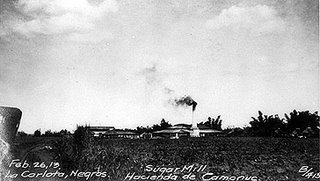
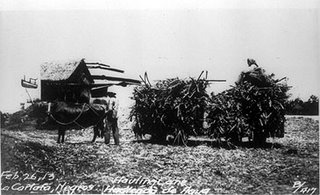
The above-cited reports seem to prove that agrarian reform has done more harm than good in Negros Occidental. By cutting up sucarcane haciendas into small parcels, you take away economies of scale, decrease farm productivity and foster inefficiency. After giving farmers land, our government pretty much left them to their own devices. Without capital and know-how, these beneficiaries soon had to indenture their land in order to feed their children.

I am sure there are a few success stories out there, but show me one succesful land reform beneficiary and I will show you a hundred who failed. Twenty years after the passage of the CARP Law, small planters of Negros and elsewhere are not better off as before. And the sad fact is, we can no longer reverse the current situation wherein CARP beneficiaries do not earn enough income from their land to pay taxes. Government just doesn't have the money to fund all these small farmers. And the people (or corporations) who do have the funds and managerial and technical ability to make agriculture more profitable are being demonized by leftist groups and some local media.
As they say - land reform is the perfect solution to a problem fifty years ago. Giving land to the landless may have worked during the time of Magsaysay but with globalization and international competition, Filipino farmers need not only "sipag at tiyaga" but also scientific knowledge and adequate capital to succeed in today's world. I guess we just have to add agrarian reform in the already long list of failed government programs in the Philippines. "Charge it to experience" as they say.


Monday, July 10, 2006

Iloilo Golf Centennial Celebration

Founded in 1907, the Iloilo Golf and Country Club in Sta. Barbara, Iloilo is the oldest golf course in the Philippines and probably in Asia. To celebrate its 100th year, IGCC this early has already announced its schedule of activities for 2007. Click here to visit its website and the schedule of golfing activities.


Sunday, July 09, 2006

Photos of Iloilo during the American Commonwealth Period (1899-1945)

Here are some old photos of Iloilo during the American Commonwealth era which I downloaded from this site.


An Ilonggo and his cock


Ilonggos are avid cockfighters, even today.


Muelle Loney port, the center of the lucrative sugar import trade. Locally-made ships called Cascos (or Batels) were used to transport muscovado sugar from neighboring sugar-producing provinces of Antique, Negros and Capiz to Iloilo City.


Calle Iznart, Iloilo City (circa 1916). Iznart Street is a major commercial center in Iloilo.


Oton Church (circa 1918) located in the neighboring municipality of Oton, Iloilo.


Sinamay weavers in Iloilo. Weaving was a thriving cottage industry in the province until cheap imported linen from Liverpool flooded local markets, effectively killing the indigenous Sinamay industry.


The old municipal hall of Arevalo, the first capital of Iloilo province. Arevalo was the site of the first Spanish settlement in Panay. The capital was later transferred to Iloilo City when Moro pirates sacked Arevalo.


A typical village in Iloilo (circa 1918).


Filipino insurgents in prison (Philippine-American War 1899-1907)


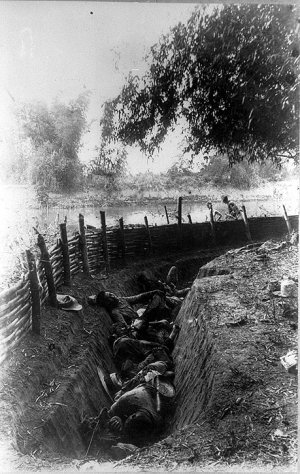
Slain Filipino revolutionaries of the Philippine-American War.


More dead rebels.


Old Mandurriao road, Mandurriao, Iloilo City (circa 1920).


Old Molo road. Molo district was known as the "Parian of Iloilo" because all Chinese immigrants (Sangleys) were then quartered there.

Saturday, July 08, 2006

Sicilians Among Filipinos

There is an unforgettable scene in Mario Puzo’s classic novel “The Godfather” where Don Vito Corleone asked his consigliere Tom Hagen the question: "Is he a Sicilian?" Don Vito was referring to Virgil "The Turk" Sollozzo who wanted to partner with the Corleone Crime Family in distributing narcotics in America and he was asking his newly-appointed counsellor for his opinion of the man.

"Is he a Sicilian?" It was a seemingly simple and straightforward question but it made Hagen pause for a few minutes. The Don obviously was not asking if Sollozo, literally, was a Sicilian. Corleone was interested to know if Sollozo had "balls" and "guts." In Mafia lingo, being a "Sicilian" meant having the strength of character to lose all you have on a point of "honor." It means having the courage to stand up for a personal affront and to stick through a fight to its end. In other words, Don Corleone wanted to know whether "the Sollozzo fellah had the guts to take on a Don if he felt slighted."

Tom Hagen answered, "Yes."

Readers may be familiar with what happened next. Don Vito Corleone said no to Sollozzo, Sollozzo felt insulted and, with the help of the other New York Five Families, instigated a "coup" against the Corleone Crime Family. When Sollozzo's assassination attempt of Don Vito failed, Michael Corleone knew that he would have to kill The Turk because, as a "Sicilian," Sollozzo will just keep on trying until he succeeds in murdering his father.

I am bringing up this scene from “The Godfather” here because I find some parallelism in it to what’s presently happening in our country today. To those who are puzzled with former Ambassador Ike SeƱeres’ seemingly “bizarre” behavior, I offer this explanation: he thinks he is a “Sicilian” and he is challenging his co-plotters to be “Sicilians” too.

I see the current maneuverings as a struggle between contending Crime Families out to attain political power for personal aggrandizement. The Corleone Family (Arroyo Administration) is constantly threatened by many Virgil Sollozzos (Gen. Danilo Lim, Col. Ariel Querubin, Magdalo soldiers, Joma Sison and his CPP/NPA), “Sicilians” who have the brains to plan and strength character to carry out their plots to topple the present government. As true “Sicilians,” these groups will not stop until they succeed, as the recent Magdalo plot to bomb Batasan proves. But more dangerous to the Corleone Family are the New York Five Families (the anonymous politicians and businessmen who fund coup plots and direct things behind the scenes).

Filipinos do not care whichever group will prevail in the end because they see the contending groups as contending Mafia gangs. Most would not allow themselves to be “used” by either group again because, as one jaded EDSA veteran said, “pauuwiin lang naman kami matapos nila makuha ang poder.” Many would rather concentrate on working and earning a salary for their families. “Sila sila lang naman ang nagpapatayan. So long as it does not affect us, it doesn’t concern us” – is a most common sentiment today.

There is a scene in “The Godfather III” where Michael Corleone asked his nephew (played by Andy Garcia) to give up his love for his daughter in exchange for his admission to the Mafia. Michael said, "That is the price you pay for the life you choose." Magdalo officers have given up promising military careers and college-educated activists squandered lucrative private-sector jobs for their principles.

My question is - Why is it that it is always the young who suffer and die? During a coup ‘d etat, it is the privates, lieutenants and captains who bear the brunt of the fighting, not the generals and admirals. During protest rallies, it is always the college students who get hurt and beaten up by police, not the Communist Party Politburo members. Why is it that only rank-and-file and middle-level government employees get jailed for corruption, not agency heads? And yet, when a plot succeeds, it is the old people who get to enjoy the "perks" of victory?